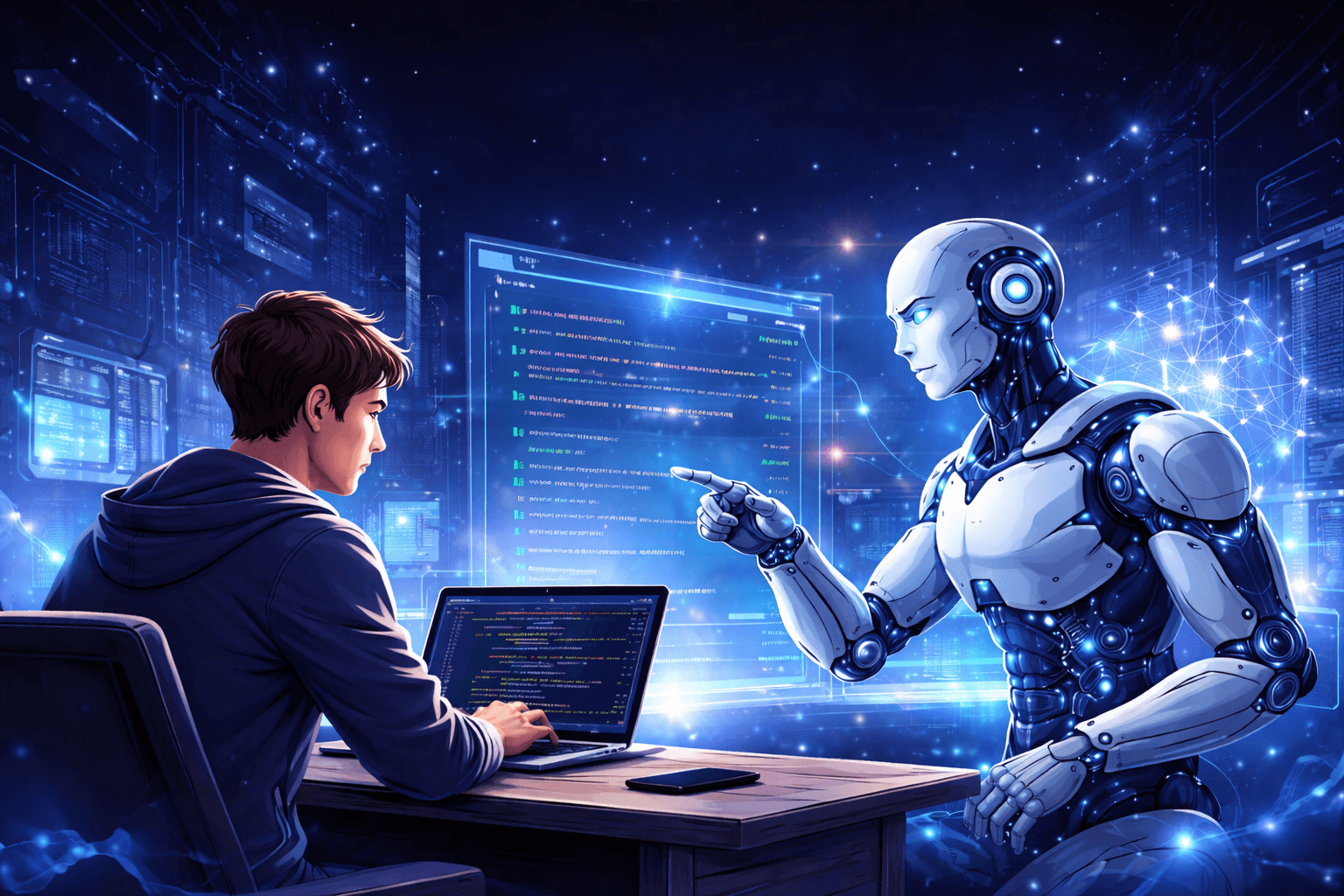
The Great Syntax Sunset: Why Intent and System Logic Are Replacing Conventional Coding in 2026
The software landscape is undergoing its most profound metamorphosis since the invention of the high level compiler. We have moved past the era of manual syntax assembly. The defining characteristic of 2026 is that system intelligence is no longer just predicting the next word; it is orchestrating the entire logic flow. The conventional software developer, long defined by their mastery of specific language specifications, must now evolve into a cognitive architect.
We are witnessing a shift from explicit instruction to conceptual intent. For half a century, we labored to learn the language of machines. We wrestled with curly braces, indentation, and complex memory models. Today, the machines have finally learned our language. This isn't just about automated code generation; it is about a partner that understands the high level intent behind the architecture. This transition is rewriting the rulebook of engineering. My own professional journey through these technological shifts has always focused on navigating this intersection of human vision and complex implementation, which you can read more about on my About Page.
Here are the critical trends defining this new era of automated creation and cognitive orchestration.
1. The Proliferation of the Independent Cognitive Agent
The biggest evolutionary leap this year is the transition from synthesis to orchestration. We have moved beyond intelligent code completion tools that merely suggest functions. We are now deploying independent cognitive agents capable of planning and executing multi step software development workflows.
These agents act as autonomous logic processors. Consider a scenario where you must migrate a critical legacy database framework to a modern scalable architecture. In 2024, this required months of specialized human labor. Today, you brief your autonomous orchestration framework on the core requirements: performance metrics, compliance standards, and data integrity constraints. The agent analyzes the entire existing codebase, generates multiple implementation strategies, tests them in isolated sandboxes, and presents the most efficient pathway.
This shift moves the engineer from a role of creation to a role of validation. We are no longer builders of individual logic bricks; we are managers of digital specialists. This focus on systems thinking over manual execution is central to my latest research on specialized agentic ecosystems and localized intelligence frameworks. You can view some of my practical work on implementing these autonomous architectures in real world scenarios at my Projects and Research section.
2. Intent Based Development and the "Vibe Coding" Philosophy
The term that has captured the industry's attention this year is "Vibe Coding." While the name might sound casual, the underlying technical philosophy is revolutionary. Vibe Coding describes a fluid development process where natural language intent is translated instantly into functioning system logic through intense real time feedback loops.
This is the absolute democratization of creation. The conventional barrier between an abstract idea and a functional prototype has collapsed. A product visionary with zero knowledge of Python or JavaScript can now express an requirement: "I need a real time dashboard that visualizes global supply chain data and flags logic exceptions based on current regulatory compliance." The cognitive system doesn’t provide a library or a snippet; it generates a complete architecture, deploys the infrastructure, and provides a functioning interface.
The critical skill for the professional engineer is no longer memorizing syntax. The new core competency is the ability to define precise constraints and curate the logical output. As the system handles the heavy lifting, the human must master the high level alignment. I frequently explore this concept of intent based design and user experience evolution, and you can find related insights on this paradigm shift over at my Blog Page.
3. The Power of Small: Specialized Edge Intelligence and Sovereign Logic
While massive global foundations continue to set benchmarks for reasoning, 2026 is defined by the strategic deployment of highly optimized localized intelligence. The one size fits all approach has failed, giving way to the era of specialized logic.
Industry specific requirements demand dedicated intelligence. Small language models, fine tuned on curated proprietary data, have become the standard for 70 percent of core operational business tasks. These compact systems provide two critical advantages that massive cloud models cannot touch: privacy and latency. In fields such as biomedical research or predictive finance, data sovereignty is non negotiable. Localized cognitive systems ensure that intelligence processing occurs entirely on private hardware, solving the "trust gap" that previously hindered adoption in regulated sectors.
This move toward edge intelligence is fundamentally a systems optimization challenge. We are building networks of specialized nodes, each a master of its own domain, collaborating to solve macroscopic problems. This decentralization of logic is creating a more resilient and responsive software ecosystem.
4. Systems Thinking and Formal Verification: The New Quality Standard
The definition of software quality has been rewritten. When machine intelligence can generate functionally perfect syntax instantly, conventional "bugs" related to language implementation errors have essentially disappeared. We are no longer hunting for missing semicolons. The new bugs are almost entirely conceptual, architectural, or logistical.
We have moved from Debugging to Verifying. As an engineer, you must audit the generated system logic to ensure it aligns with the original intent and satisfies complex business requirements. This requires an advanced capability in formal verification, system validation, and deductive reasoning. We are shifting focus from how the code works to whether the system should work that way.
The professional of the future is an expert in reading, not writing. We are the guardians of the ethical alignment and safety constraints. The new software stacks must be designed for interpretability, ensuring that even as autonomous systems make execution decisions, the human remains the final authority on system logic and security.
Conclusion: Orchestrating the Future of System Logic
Machine intelligence is not a threat to software engineering; it is its liberation. We are being unchained from the repetitive mechanics of code assembly so that we can focus on the macroscopic, creative, and ethical aspects of system design.
The transition from a code first paradigm to a logic first world is the most significant evolutionary step I have seen in this industry. Navigating this new landscape requires a forward thinking technical partner who understands both the raw power of the emerging technology and the practical needs of enterprise system design. I am constantly seeking new frontiers and challenging projects that push the boundaries of what is possible with cognitive systems.
Visit my Contact Section to discuss how we can build the logic for your next great system architecture.